


There is no disease equal to greed. There is no enemy greater than anger. There is no sorrow that is greater than poverty. There is no happiness equal to wisdom....Vedic Wisdom
"...The word Veda is derived from the Sanskrit root Vid, meaning knowledge of jnana. Easwara jnana (knowledge of the Lord) is Veda. Atma jnana (knowledge of the Self) is Veda. Brahma jnana (knowledge of the supreme Absolute) is Veda. Adwaitha jnana (non-dual knowledge) is Veda. Veda is vijnana (knowledge par excellence). All these terms are synonyms for Self-knowledge or Atma jnana...."
"...The word Veda is derived from the Sanskrit root Vid, meaning knowledge of jnana. Easwara jnana (knowledge of the Lord) is Veda. Atma jnana (knowledge of the Self) is Veda. Brahma jnana (knowledge of the supreme Absolute) is Veda. Adwaitha jnana (non-dual knowledge) is Veda. Veda is vijnana (knowledge par excellence). All these terms are synonyms for Self-knowledge or Atma jnana...."
Bhagawan
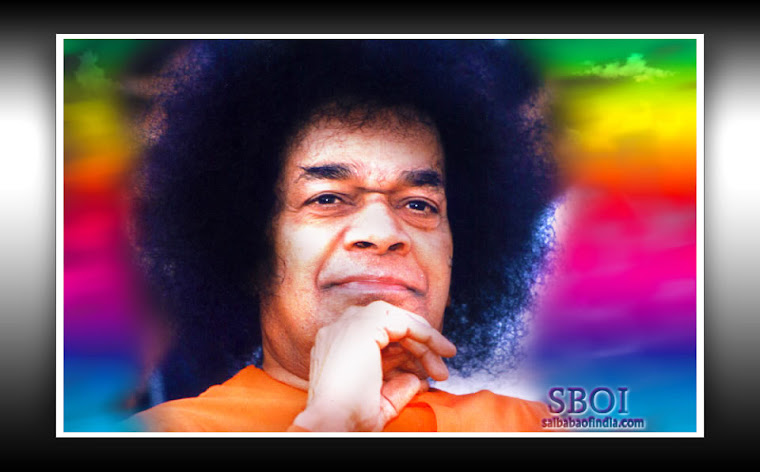
Sri Sathya Sai Baba would often say, “My life is My Message.”
A simple understanding of
this declaration is that He lives every day the message He teaches.
One
other meaning one could draw is that, ‘His message is His life’!
That
is, the message that Bhagawan gave is the very life essence of His
descent as an Avatar.
And the fact that even today, we can go through
the thousands of discourses He delivered is in itself a sign of His
benediction upon us.
Vedic Wisdom
3 June 1990
3 June 1990
There is no disease equal to greed.
There is no enemy greater than anger.
There is no sorrow that is greater than poverty.
There is no happiness equal to wisdom.
Belief in God has declined.
Dharma has disappeared.
Atheism is on the increase.
There is no respect for the guru-preceptor.
Devotion to God, respect for our ancient culture,
and tradition have been given farewell.
There is no patronage for true education.
Only bread-earning education has become the order of the day.
These, alas! Are the signs of modernity!
Dharma has disappeared.
Atheism is on the increase.
There is no respect for the guru-preceptor.
Devotion to God, respect for our ancient culture,
and tradition have been given farewell.
There is no patronage for true education.
Only bread-earning education has become the order of the day.
These, alas! Are the signs of modernity!
“I am in the Light;
The Light is in me;
I am the Light.”
The Light is in me;
I am the Light.”
The jnani who has realised thus will surely become one with Brahman.
Dear Students!
The Vedic literature is the most ancient in the world. It is a treasure house of wisdom.
It has contributed to the all-round development of man. The Veda is the first-ever book in
human history. It is the birthplace for human culture and the basis for all kinds of powers.
All branches of learning have their origin in the Veda. All dharmas and virtues have
sprung from the Veda. The Veda is endless, unfathomable, indefinable, and blissful. The
word Veda is derived from the Sanskrit root Vid, meaning knowledge of jnana. Easwara
jnana (knowledge of the Lord) is Veda. Atma jnana (knowledge of the Self) is Veda.
Brahma jnana (knowledge of the supreme Absolute) is Veda. Adwaitha jnana (non-dual
knowledge) is Veda. Veda is vijnana (knowledge par excellence). All these terms are
synonyms for Self-knowledge or Atma jnana.
The divinity of the Veda is all-pervasive
and has eight aspects of splendour, viz., sabda Brahma-mayee (sound Brahman),
charachara mayee (movable and immovable), jyothirmayee (effulgence), vaangmayee (speech and literature), nityaananda mayee (everlasting bliss) paratpara mayee (transcendental),
maya mayee (delusion), and sree mayee (prosperity). This is indeed the
Prajnanamaya Brahma (constant integrated awareness). It does not pertain to one individual,
one place or time. It is universal. Knowing that it is not possible for ordinary people
to understand such sacred Vedic literature, Sage Vyasa compiled it into four volumes.
The Veda consists of three “kandaas” or Cantos, namely, Karma Kaanda (cantos
dealing with rituals and other actions), Upasana Kaanda (cantos of devotion), and Jnana
Kaanda (cantos of wisdom). These three divisions represent the progressive steps in
man’s spiritual evolution. Man starts with actions, recognising that the human body is
meant for achieving dharma (righteousness) through karma. When he goes on performing
good karmas, he will in due course become fit for understanding Upasana (devotional
practices). When he worships God over a period of time, with love and in a spirit of dedication,
he attains the final stage of Jnana. On the whole, karma, upasana, and jnana may
be considered as three stages of one process, comparable to the flower, the raw fruit, and
the ripe fruit respectively. Since the common people cannot understand and practise the
teachings of the Veda, subsidiary literature has been created later in the form of Puranas (mythological treatises) and Ithihasas (epics), so that even the lay people can practise
karma, upasana, and jnana.
The end of the Veda is Upanishad, which is therefore, called Vedanta. The Upanishads
have named the three paths of karma, upasana, and jnana as yogas. The essence of
karma yoga is to dedicate all actions to God or to perform all activities as offerings to the
Lord, for His pleasure. Upasana yoga consists of loving God whole-heartedly and with
trikaranasuddhi i.e., harmony and purity of thought, word, and deed. It is not true
upasana if one loves God for the sake of achieving his worldly desires. It should be love
for love’s sake. The followers of jnana yoga consider the whole universe as the manifestation
of God. Believing that Divinity resides in all beings in the form of Atma, is called
Jnana. Students may wonder how there can be Ekatwa (Oneness) when there are so many
different forms and names, different kinds of behaviour, and different doctrines etc. This
doubt can be cleared by considering the example of an ocean. In the fathomless ocean,
there are numberless waves. Each wave is different from the other in its size, shape, etc.
and it looks as though there is no connection between one wave and another. But a little
thinking will reveal to you the fact that they are all different manifestations of one and the
same water, and also that they are not different from the ocean. In the same manner, all
the different names and forms in the universe are the waves or manifestations of the one
and the same ocean of Sath-Chith-Ananda (Existence-Awareness-Bliss). Hence, the essence
of all manifested beings is only Sath-Chith-Ananda, despite the superficial or apparent
differences in names and forms and their behaviour.
The Bhagavad Gita, which came into existence later, is the essence of the Upanishads.
However, it deals with the path of karma, upasana, and jnana in three shatkas,
each shatka comprising six chapters, thus making up the total of eighteen chapters in the
Gita. The first shatka deals with the path of karma, the second one with the path of
upasana, and the third one with the path of jnana. To sum up, the Veda gave rise to the
Upanishads, which in turn gave rise to the Bhagavad Gita, which serves as a practical
guide for human conduct. The Bhagavad Gita is not the property or monopoly of the Indians.
It is the word of God and is, therefore, a universal scripture. There is only one God
for all, although there may be different religions and different names and forms of God.
In whatever name and form one may worship, it reaches the one and only God. There is
only one sun. There are no separate suns like American sun, British sun, Chinese sun, Indian
sun, Pakastani sun, and so on. Each country may see the sun at a different time. Just
because all of them cannot see the sun at the same time, it will be foolish to think that
there are different suns for different countries.
Vedas have very vast, profound and deep meanings. The gurus or preceptors of ancient times used to adopt stern measures and enforce strict discipline while teaching the Vedas to their students. That is why the Vedas have survived till today, successfully withstanding the onslaught of time. Actually, the Vedas are not books in the usual sense of that term. No one claims authorship for them. They are called Sruthis or knowledge acquired through hearing. Since time immemorial, the Vedas have been coming down through a succession of gurus and disciples through the process of hearing. The gurus used to utter the mantras with particular intonations, which were prescribed for the purpose and scrupulously followed by the disciples. The gurus of those days were selfless, pure-hearted, and overflowing with love for their students, but unsparing in the matter of discipline among the students. The students too were generally observing the required discipline very scrupulously. If anyone disobeyed the master, he would be summarily dismissed from attending the classes. The gurus would never tolerate any student who was guilty of one or more of the akara panchaka arishtas or the five transgressions beginning with the letter “A,” viz., alakshyam (negligence), avinayam (disobedience), ahamkaram (ego), asuya (jealousy), and asabhyata (lack of social etiquette).
Vedas have very vast, profound and deep meanings. The gurus or preceptors of ancient times used to adopt stern measures and enforce strict discipline while teaching the Vedas to their students. That is why the Vedas have survived till today, successfully withstanding the onslaught of time. Actually, the Vedas are not books in the usual sense of that term. No one claims authorship for them. They are called Sruthis or knowledge acquired through hearing. Since time immemorial, the Vedas have been coming down through a succession of gurus and disciples through the process of hearing. The gurus used to utter the mantras with particular intonations, which were prescribed for the purpose and scrupulously followed by the disciples. The gurus of those days were selfless, pure-hearted, and overflowing with love for their students, but unsparing in the matter of discipline among the students. The students too were generally observing the required discipline very scrupulously. If anyone disobeyed the master, he would be summarily dismissed from attending the classes. The gurus would never tolerate any student who was guilty of one or more of the akara panchaka arishtas or the five transgressions beginning with the letter “A,” viz., alakshyam (negligence), avinayam (disobedience), ahamkaram (ego), asuya (jealousy), and asabhyata (lack of social etiquette).
Vysampayana was the foremost among the disciples who learnt the Vedas from the
Sage Vyasa. Vysampayana sanctified his life by implicitly obeying his guru and by
learning his lessons studiously and thoroughly. After completing his studies, Vysampayana
established a Gurukula—for teaching the Veda to his disciples. By Gurukula is
not meant a separate institution with its own set of rules and regulations like the presentday
schools and colleges. The guru’s house itself constituted the Gurukula. Whatever
kind of food the guru ate was given to the disciple as prasad—holy food. The disciple
should stay with the guru day and night. One disciple by name Yajnavalkya joined
Vysampayana’s Gurukula. He had a keen intellect and could learn his lessons very fast.
The guru was also highly pleased with him. People who knew Yajnavalkya began praising
him with the result that he developed ahamkaram (ego) followed gradually by
alakshyam (indifference) and asabhyata (lack of decorum.) Vysampayaan noticed these
lapses on the part of Yajnavalkya. One day, he called him and told him sternly, “Yajnavalkya!
You don’t deserve to stay in this Gurukul any longer. You must leave this place
immediately. Before you leave, you must return all that you have learnt from me.” Accordingly,
Yajnavalkya, who recognised his own shortcomings, vomited all that he had
learnt from his guru. His vomitings were eaten by tittiri birds, and the latter began
chanting the Upanishad, which was therefore named as Taittireeya Upanishad.
There are two traditions or sampradayas in the Veda, viz., Brahma sampradaya and
Aditya sampradaya. That which was vomited by Yajnavalkya came to be known as the
Brahma Sampradaya, also called the Krishna Yajur Veda. After leaving the Gurukul of
Vysampayana, Yajnavalkya sincerely repented for his delinquency and atoned for it by
giving up food and drink and practised Suryopasana (Sun worship) ,undergoing severe
austerities by way of penance. Pleased with this penance, the Sun God appeared before
him in the form of Vaaji and told him, “My child! What is past is past. You should guard
yourself against such lapses in future. Betraying the guru or God is highly dangerous. Be
careful hereafter, I will now teach you the Vedas again.” So saying, the Sun God taught
him the Vedas. The reason for the Sun appearing in the form of Vaaji was that Yajnavalkya’s
forefathers always used to do anna dana (free distribution of food), so their family
got the name Vaajasam. The Veda taught by him was also called by the alternative names
of Sukla Yajur Veda, Vajasas Khanda, and Aditya Khanda. Yajur Veda has been divided
into two. For this reason, although the Vedas were originally four in number, they have
subsequently become five, namely Rig Veda, Krishna Yajur Veda, Sukla Yajur Veda,
Sama Veda, and Atharvana Veda. Recognising that the Sun appeared before him as Vaaji and taught him the Vedas because of the free distribution of food by his ancestors, Yajnavalkya gave primary importance to anna daana in his teaching which, among others, included
the following:
“There is no gift higher than the gift of food and no God higher than the parents.
There is no truth higher than japa and thapas (reciting the holy Name and doing penance).
There is no dharma higher than compassion and no gain higher than the company
of the good. There is no enemy more dangerous than anger and no disease more serious
than indebtedness. There is no death more horrible than ill-fame and no wealth more
valuable than fame. There is no ornament more beautiful than smaran (remembering God
through chanting His names).” Yajnavalkya, moreover, emphasised specially in his
teachings to his disciples the extreme importance of service to parents and guru, as well
as anna dana (free distribution of food).
Students! we began these classes on the holy Ekadasi day—day eleven of the lunar
fortnight, and we are also concluding the classes on this Ekadasi day. Hence, you should
consider all these classes as Ekadasi Vratam (observance of the vows of Ekadasi). During
the fortnight, you have had the valuable opportunity of listening to the lectures from
highly distinguished speakers, with rich experience behind them. What they taught you
with wholehearted zeal and enthusiasm you have listened carefully with much interest
and faith. But what is more important than listening is to put into practice at least some of
the things you have learnt and thereby to set an example for others to follow.
You must always remember the five life-breaths relating to the Vedas, which I mentioned
earlier. You should avoid these five things: (1) indifference to what the guru, parents,
and other elders teach you, (2) disobedience to the aforesaid, (3) ahamkara (ego),
(4) jealousy or envy toward those who are better off, and (5) violating the social etiquette
or decorum.
Students! What has been taught to you during these fifteen days is the essence of the
sacred Vedanta. What has been given to you is the nectar obtained by the churning of all
the holy scriptures—Sastras, Puranas, and Ithihasas. You are the future leaders, pleaders,
and patrons of Mother India. You should lead exemplary lives, treading the path of
sathya and dharma (truth and righteousness). Under no circumstances should you deviate
from this ideal path. Let your secular education go hand in hand with spiritual education.
The Vedas have taught about two kinds of dharma: vihita dharma and nishiddha
dharma (prescribed dharma and prohibited dharma); in other words, the Do’s and Don’ts
for regulating one’s life. Unfortunately, today, the prescribed things are being given up
and the prohibited things are being taken up. This is sheer folly and ignorance. The prohibited
things should be rejected, even though you might have taken lots of trouble to acquire
them. For instance, you have purchased from the market a big mango fruit for five
rupees. Just because you have spent five rupees on it, will you eat the skin outside and the
stone inside the fruit? No, no. You will eat only the pulp and reject both the skin and
stone. Similarly this world is like a fruit, and you have to accept what is good in it and
reject what is bad for you.
Students! You are
highly fortunate. Even though there are several millions of people
in the world, is it not your exceedingly good luck that only you, who
are but a few hundreds
in number, have been able to get the benefit of this golden opportunity?
However,
the purpose of this Summer Course will be served only if at least some
of you stand as
exemplars to others. You may take up any job, business, or agriculture
and occupy any
position in your life, but it is extremely important that you do not
lose self-confidence
while discharging your duties. Lack of Self-confidence is the main cause
for all the present-day problems like foul play, injustice, losses,
failures, sorrow, and pain. People do
not believe in themselves, not to speak of believing others. First of
all, develop Selfconfidence,
and that in turn will give you self-satisfaction. Without
self-satisfaction, you
cannot have contentment. Once you have gained self-satisfaction, then
automatically you
will be ready for self-sacrifice. Needless to say, where there is
self-sacrifice, there will be
Self-realisation naturally.
Every student should undertake sathkarmas (good actions) which lead to chitta suddhi (purity of mind). Where there is purity, there will be jnana siddhi (dawn of wisdom).
These are all within yourself only. You need not search for them anywhere outside. In
this connection, let us consider the example of the wall-clock over there. It has three
hands to indicate seconds, minutes, and hours respectively. There are sixty points, and
twelve hours marked along the circumference of the clock. When the second-hand moves
across all the sixty points, the minute-hand moves by only one point. When the minutehand
moves over sixty points or the full circumference, the hour-hand moves by only one
hour-mark or one-twelfth of the circumference. Now, the second-hand may be compared
to our actions. If a large number of good actions are done, the minute-hand, which represents
chitta suddhi (the purity of mind), will move by one point. Chitta suddhi is the stage
of upasana when one engages himself in loving God and worshipping Him in various
ways over a period of time, leading to Atma viswaasam (Self-confidence), which represents
the hour-hand. The perceptible move-ments of the second-hand and the minutehand
should bring about the imperceptibly slow movement of the hour-hand. Otherwise,
no purpose is served by the second-hand and minute-hand. So also, unless your good actions,
worship and love of God, lead to Atmaviswas or Self-confidence, the former two
will be futile.
Whenever you have time, it will suffice if you take up at least one of the nine modes
of bhakthi (such as sravanam, kirtanam, etc., already explained to you in My earlier discourses).
God does not consider how wealthy or how learned you are; He is concerned
only with the sincerity and purity of your mind and heart and about how whole-hearted
and genuine your love is. Valkimi was a hunter. Nanda was an untouchable. Kuchela was
a pauper. Dhruva and Prahalada were mere lads of five years. Sabari was a tribal woman,
illiterate and uncivilised. But all of them had won God’s Grace in abundance, because of
their wholehearted devotion, love and surrender. Follow the example of Sabari, who always
thought of Sri Rama and His happiness, and dedicated all her thoughts, words, and
deeds to Him alone, so much so that every action of hers was transformed and sublimated
into the highest thapas (penance.) From her example, you must learn the lesson that
meditation does not mean sitting idle in a particular posture of the body, as if you are
posing for a photograph. As in her case, your entire life must become a continuous
meditation wherever you may be staying and whatever you may be doing. Whatever you
eat or drink must be offered to God as naivedya or holy offering. In this manner, if you
offer everything to the Lord, you will naturally be prevented from engaging yourself in
bad actions or evil ways in your life. Therefore, students! I am bringing My long discourse
to a close, with the hope and blessing that you will practice with your hands what
you have heard here through your ears, and thereby sanctify your lives and also contribute
your share to make the future of Bharath (India) bright and prosperous.
- Team Radio Sai
What do you think about this series? Please let us know by writing in to h2h@radiosai.org. Do not forget to mention your name and country.