July, Tuesday 16th., 2019 A Sultan Shines In The Court Of The Dragon King
July, Tuesday 16th., 2019
According to President Xi's following phrase, are we supposed to conclude that China is going to stand by the side of Cyprus and Greece concerning their international rights and sovereignty? That Turkey will be encouraged to uphold a multilateral world order with the United Nations at its core?Aka, half the East Mediterranean Sea will not be given as food to a sultanic, narcissistic, internationally bullying and greedy attitude, despite all dharma and righteousness? Maria L. Pelekanaki
"...Xi, as he welcomed Erdogan in Beijing, stressed the message he
crafted together with Putin in their previous meetings in St Petersburg,
Bishkek and Osaka: China and Turkey should “uphold a multilateral world
order with the United Nations at its core, a system based on
international law.”..."
"..Addressing the extremely sensitive Uighur dossier head on, Erdogan deftly executed a pirouette. He
eschewed accusations from his own Foreign Ministry that “torture and
political brainwashing” were practiced in Uighur detention camps and
would rather comment that Uighurs “live happily” in China. “It is a fact
that the peoples of China’s Xinjiang region live happily in China’s
development and prosperity. Turkey does not permit any person to incite
disharmony in the Turkey-China relationship.”..."
A Sultan Shines In The Court Of The Dragon King
Authored by Pepe Escobar via The Saker blog, The graphic image of Turkey pivoting away from NATO
towards the Russia-China strategic partnership was provided, in more
ways than one, by Turkish President Tayyip Erdogan visiting Chinese
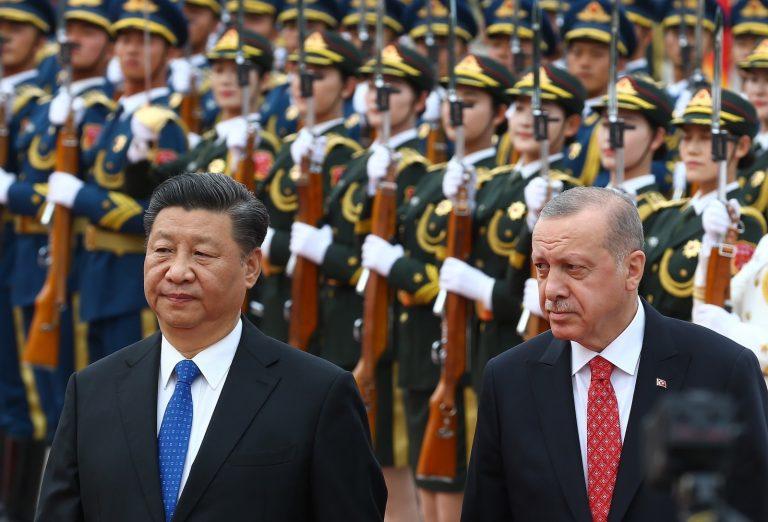
President Xi Jinping in Beijing right after the G20 in Osaka. BEIJING, CHINA – JULY 02: President of Turkey, Recep Tayyip
Erdogan (R) and Chinese President Xi Jinping (L) walk past the honor
guards during an official welcoming ceremony at Great Hall of the People
in Beijing, China on July 02, 2019. Volkan Furuncu / Anadolu Agency
Turkey is a key hub in the emerging New Silk Roads, or Belt
and Road Initiative. Erdogan is a master at selling Turkey as the
ultimate East-West crossroads. He has also expressed much
interest in joining the Shanghai Cooperation Organization (SCO), led by
Russia-China, whose annual summit took place in Bishkek a few days
before Osaka.
In parallel, against hell and high water – from threats of sanctions
by the US Congress to NATO warnings – Erdogan never budged from Ankara’s
decision to buy Russian S-400 defense missile systems, a $2.5-billion
contract according to Rostec’s Sergei Chemezov. The S-400s start to be shipped to Turkey as early as this week. According
to Turkish Minister of Defense Hulusi Akar, their deployment should
start by October. Much to Washington’s ire, Turkey is the first NATO
member state to buy S-400s. Xi, as he welcomed Erdogan in Beijing, stressed the message he
crafted together with Putin in their previous meetings in St Petersburg,
Bishkek and Osaka: China and Turkey should “uphold a multilateral world
order with the United Nations at its core, a system based on
international law.”
Erdogan, for his part, turned up the charm – from publishing an op-ed in the Global Times extolling a common vision of the future to laying it out in
some detail. His target is to consolidate Chinese investment in
multiple areas in Turkey, directly or indirectly related to Belt and
Road. Addressing the extremely sensitive Uighur dossier head on, Erdogan deftly executed a pirouette. He
eschewed accusations from his own Foreign Ministry that “torture and
political brainwashing” were practiced in Uighur detention camps and
would rather comment that Uighurs “live happily” in China. “It is a fact
that the peoples of China’s Xinjiang region live happily in China’s
development and prosperity. Turkey does not permit any person to incite
disharmony in the Turkey-China relationship.” This is even more startling considering that Erdogan himself, in the past decade, had accused Beijing of genocide. And
in a famous 2015 case, hundreds of Uighurs about to be deported from
Thailand back to China ended up, after much fanfare, being resettled in
Turkey.
New geopolitical caravan
Erdogan seems to have finally realized that the New Silk
Roads are the 2.0 digital version of the Ancient Silk Roads whose
caravans linked the Middle Kingdom, via trade, to multiple lands of
Islam – from Indonesia to Turkey and from Iran to Pakistan.
Before the 16th century, the main line of communication across
Eurasia was not maritime, but the chain of steppes and deserts from
Sahara to Mongolia, as Arnold Toynbee wonderfully observed. Walking the
line we would find merchants, missionaries, travelers, scholars, all the
way to Turko-Mongols from Central Asia migrating to the Middle East and
the Mediterranean. They all formed the stuff of interconnection and
cultural exchange between Europe and Asia – way beyond geographical
discontinuity.
Arguably Erdogan is now able to read the new tea leaves. The
Russia-China strategic partnership – directly involved in linking Belt
and Road with the Eurasia Economic Union and also the International
North-South Transportation Corridor – considers Turkey and Iran as
absolutely indispensable key hubs for the ongoing, multi-layered Eurasia
integration process. A new Turkey-Iran-Qatar geopolitical and economic axis is
slowly but surely evolving in Southwest Asia, ever more linked to
Russia-China. The thrust is Eurasia integration, visible for
instance via a frenzy of railroad building designed to link the New Silk
Roads, and the Russia-Iran transportation corridor, to the Eastern
Mediterranean and the Red Sea and, eastwards, the Iran-Pakistan corridor
to the China-Pakistan Economic Corridor, one of Belt and Road’s
highlights. This is all being supported by interlocking transportation cooperation agreements involving Turkey-Iran-Qatar and Iran-Iraq-Syria.
The end result not only consolidates Iran as a key Belt and Road
connectivity hub and China’s strategic partner, but also by contiguity
Turkey – the bridge to Europe.
As Xinjiang is the key hub in Western China connecting to multiple
Belt and Road corridors, Erdogan had to find a middle ground – in the
process minimizing, to a great extent, waves of disinformation and
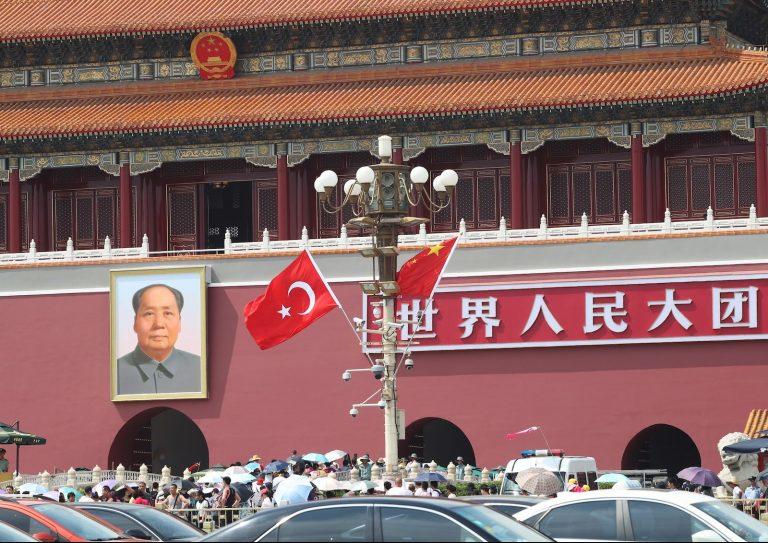
Western-peddled Sinophobia. Applying Xi Jinping thought, one would say Erdogan opted for privileging cultural understanding and people-to-people exchanges over an ideological battle. The flags of China and Turkey flutter in Beijing during Erdogan’s visit to China on July 2. Photo: Wang Xin/ ImagineChina / AFP
Ready to mediate
In conjunction with his success at the court of the Dragon
King, Erdogan now feels emboldened enough to offer his services as
mediator between Tehran and the Trump administration – picking up on a
suggestion he made to Japanese Prime Minister Shinzo Abe at the G20.
Erdogan would not have made that offer if it had not been discussed
previously with Russia and China – which, crucially, are member
signatories of the Iran nuclear deal, or Joint Comprehensive Plan Of
Action (JCPOA).
It’s easy to see how Russia and China should consider Turkey the
perfect mediator: a neighbor of Iran, the proverbial bridge between East
and West, and a NATO member. Turkey is certainly much more
representative than the EU-3 (France, UK, Germany).
Trump seems to want – or at least gives the impression of imposing – a
JCPOA 2.0, without an Obama signature. The Russia-China partnership
could easily call his bluff, after clearing it with Tehran, by offering a
new negotiating table including Turkey. Even if the ineffective – in
every sense – EU-3 remained, there would be real counterbalance in the
form of Russia, China and Turkey. Out of all these important moves in the geopolitical
chessboard, one motivation stands out among top players: Eurasian
integration cannot significantly progress without challenging the
Trumpian sanction obsession.