

Saturday, December 9th., 2017
Only just a small addition to the title below: As many sources say,
The Turkish President forced himself as a 'visitor' and force-funneled his visit to the Greek Nation just to show-off as the new muslim-daddy-guarantor, using the 'nasty-bullying boy's techniques', including a vulgar-macho-sitting on the sofa-style*, which his polite gentleman Host allowed, not to actually embarrass him. Fact not finally avoided though, despite all hospitality efforts, when the Turkish President himself admitted that
'he does not know about International Laws, or Justice, or Human Rights, or Philosophical, Theoritical, Analytical Values et al, but, he just knows and understands the 'political law',
aka the violent imposition of one man's will , which I guess is called 'dictatorship' in many parts of the world.
He also hardly tried to hide his salivating over the Greek energy sources, (aka Aegean Sea and Islands), that he falsely thinks , if grabbed, will save him from the upcoming difficulties...
Therefore "Turkey and Greece DID NOT re-open old woods..."!
Greece had to diplomatically accept and handle a Predatory visit from the Psychologically and Geophysically Unstable, obviously dangerous, bully-neighbour, who tries to dictatorically survive and narcissistically reassure his adoration of Himself, which he cannot get from around him and immaturely thinks that Humanity owes him, to the cost of many... !
Thus the Title below ends up, selon moi, like this:
Greece had to diplomatically accept and handle a Predatory visit from the Psychologically and Geophysically Unstable, obviously dangerous, bully-neighbour, who tries to dictatorically survive and narcissistically reassure his adoration of Himself, which he cannot get from around him and immaturely thinks that Humanity owes him, to the cost of many... !
Thus the Title below ends up, selon moi, like this:
!"Turkey tried hard to re-open old wounds with Greece in borderline argument"!
And let us hope that ALL Greek Political Personnel got the ugly message and will asap unite in an educated, brave and not self-centered, short and long-run diplomatic, ethnic and international, political, social, economic, historic, academic concept/strategy/implementation, to secure and enhance Hellenism and Greece and secure Peace in Southern Balkans.
Maria L. Pelekanaki
*The body-language experts teach that only a tiny centimetre -or two- make the whole difference in the sitting style of the self-confident A male, or an idiotic unsociable, or the next bush /corner stalking pathological , pyhysical or psychological , rapist...
And let us hope that ALL Greek Political Personnel got the ugly message and will asap unite in an educated, brave and not self-centered, short and long-run diplomatic, ethnic and international, political, social, economic, historic, academic concept/strategy/implementation, to secure and enhance Hellenism and Greece and secure Peace in Southern Balkans.
Maria L. Pelekanaki
*The body-language experts teach that only a tiny centimetre -or two- make the whole difference in the sitting style of the self-confident A male, or an idiotic unsociable, or the next bush /corner stalking pathological , pyhysical or psychological , rapist...
Turkey & Greece re-open old wounds in borderline argument
''...During the first in half a century visit, the Turkish president saw fit to speak of “outstanding issues”
with the Treaty of Lausanne, whereby Turkey ceded territory which it
had possessed under the Ottoman Empire. Greece being one of those
territories, Pavlopoulos naturally described the treaty as “non-negotiable.”Greek Prime Minister Alexis Tsipras could be expected to express discord with Erdogan’s position, and the genuinely baffling nature of Erdogan’s stance provided an easy route for Tsipras to follow.
“The truth, is I’m a little confused regarding if what he is putting on the table is to modernize, to update, to comply with the Lausanne Treaty,” the PM said, as cited by Reuters.
Erdogan has said in the past that he has no intention of redrawing Turkey’s borders, and uninhabited islands in the Aegean Sea have been enough to bring the nations close to war in recent years...''
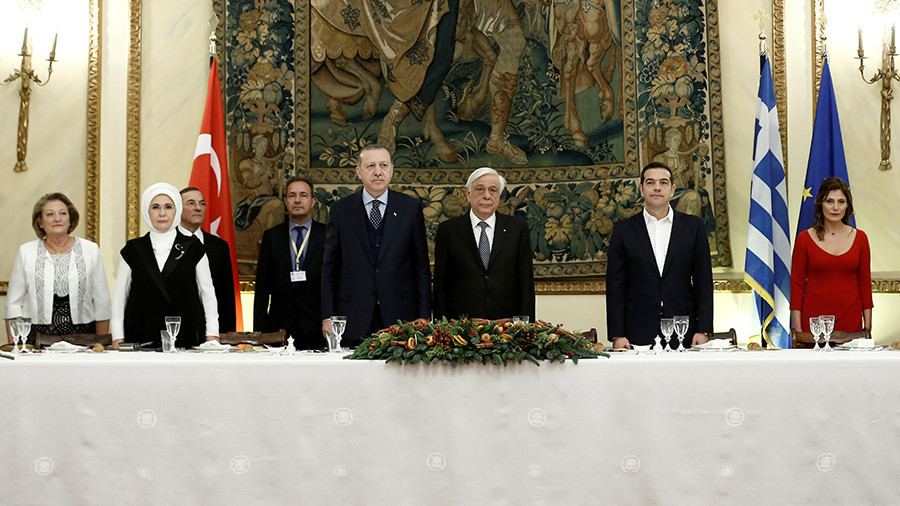
The presidents of Turkey and Greece, Recep Tayyip Erdogan and
Prokopis Pavlopoulos respectively, made sure that the former’s historic
visit to Greece went beyond anodyne pleasantries. The matter at hand was
interpretation of the 1923 Treaty of Lausanne.
In his
first visit as president, the first such visit by any Turkish president
since 1952, Recep Tayyip Erdogan walked along the red carpet in Athens
on Thursday, flanked by his Greek counterpart, Prokopis Pavlopoulos. If
ever a host nation pulled out all the stops for a visitor, then Greece
did so on this occasion: Athens ground to a halt as thousands of police
and security personnel left nothing to chance.
Such an approach was in accordance with that adopted by Turkey since the attempted coup of 2016, which killed 250 people and left almost nine times that number injured. Followers of the exiled Turkish preacher Fethullah Gulen, who resides in the United States and whom Ankara blames for the coup, are dubbed the ‘Gulenist Terrorist Organisation’ (FETO) by Turkish authorities. Scores are arrested on a regular basis, and around a thousand Turks have sought political asylum in Greece on this basis, according to Turkish FM Mevlut Cavusoglu as cited by Anadolu Agency.
In response to extradition requests, Greece has said that they ought to be founded upon something more solid than mere circumstantial evidence, according to Hurriyet.
READ MORE: Erdogan urges Lausanne Treaty be revised
During the first in half a century visit, the Turkish president saw fit to speak of “outstanding issues” with the Treaty of Lausanne, whereby Turkey ceded territory which it had possessed under the Ottoman Empire. Greece being one of those territories, Pavlopoulos naturally described the treaty as “non-negotiable.”
Greek Prime Minister Alexis Tsipras could be expected to express discord with Erdogan’s position, and the genuinely baffling nature of Erdogan’s stance provided an easy route for Tsipras to follow.
“The truth, is I’m a little confused regarding if what he is putting on the table is to modernize, to update, to comply with the Lausanne Treaty,” the PM said, as cited by Reuters.
Erdogan has said in the past that he has no intention of redrawing Turkey’s borders, and uninhabited islands in the Aegean Sea have been enough to bring the nations close to war in recent years. The tension stems in part from the rights of access, attendant to control of the islands, to various minerals which lie below the sea. Erdogan also pointed out that Turkey has been a NATO member for a longer continuous period than Greece has, and that the Muslim minority in the country needs a guarantor.
Erdogan is no stranger to controversy, having to all intents and purposes re-shaped the office of Turkish president in his own image. Even before the failed coup, Erdogan had to contend with a restive Kurdish population in his country’s east, as well as balancing NATO membership and maintaining ties with Russia, Iran and the Gulf monarchies. Relations with Greece would be a Gordian knot for any Turkish leader.
There are deep historic roots for the pride of both nations, and those roots are intertwined. The Ottoman Empire was the main power in the Middle East for centuries, and at its peak under Suleiman the Magnificent was arguably the most powerful empire in the world. Ancient Greece is widely regarded as the cradle of philosophy, literature and democracy, and its marriage with Rome gave the world Byzantium and its capital of Constantinople. Over time, the Turks pushed westward, while European crusaders pushed eastward. The fourth crusade involved the sack of Constantinople – western Christians robbing and murdering eastern Christians. The historian Runciman stated flatly that “never was a greater crime committed.”
The subsequent Turkish conquest of Constantinople led to its renaming as Istanbul, and the Ottoman Empire expanded into Greece and the Balkans. The strength of the Russian Empire curbed Ottoman ambitions for a time, but the Great War dragged everyone in and led to the destruction of Smyrna – now Izmir – in 1922. This set the seal on Turkey’s reputation for the Greeks to this day.
By the Second World War, Greece was surrounded by Communist governments and seemed to be going down the same road. The West allegedly resorted to desperate measures to ensure that Greece’s ports and shipyards did not become available to Stalin. By contrast, and like other Mediterranean countries, Greece has experienced fascism, and in what proved to be one of its last acts, the Greek junta annexed the island of Cyprus in 1974. The Turks responded by invading the north of the island, which remains de facto partitioned to this day. While elsewhere in Europe Turkish membership in the EU is a bone of contention, the Cypriot question has been the usual flashpoint for Graeco-Turkish relations in recent years.
Erdogan’s visit, however, may herald a more direct approach. Such an approach may be a deliberate choice, as waves of migrants continue to use Turkey as a conduit to enter Greece and thus the EU, and the two countries are now linked by the Interconnector pipeline. Also, Turks continue to live in Greece, in Thrace, and Erdogan made sure to visit them on the second and final day of his visit on Friday.
Such an approach was in accordance with that adopted by Turkey since the attempted coup of 2016, which killed 250 people and left almost nine times that number injured. Followers of the exiled Turkish preacher Fethullah Gulen, who resides in the United States and whom Ankara blames for the coup, are dubbed the ‘Gulenist Terrorist Organisation’ (FETO) by Turkish authorities. Scores are arrested on a regular basis, and around a thousand Turks have sought political asylum in Greece on this basis, according to Turkish FM Mevlut Cavusoglu as cited by Anadolu Agency.
In response to extradition requests, Greece has said that they ought to be founded upon something more solid than mere circumstantial evidence, according to Hurriyet.
READ MORE: Erdogan urges Lausanne Treaty be revised
During the first in half a century visit, the Turkish president saw fit to speak of “outstanding issues” with the Treaty of Lausanne, whereby Turkey ceded territory which it had possessed under the Ottoman Empire. Greece being one of those territories, Pavlopoulos naturally described the treaty as “non-negotiable.”
Greek Prime Minister Alexis Tsipras could be expected to express discord with Erdogan’s position, and the genuinely baffling nature of Erdogan’s stance provided an easy route for Tsipras to follow.
“The truth, is I’m a little confused regarding if what he is putting on the table is to modernize, to update, to comply with the Lausanne Treaty,” the PM said, as cited by Reuters.
Erdogan has said in the past that he has no intention of redrawing Turkey’s borders, and uninhabited islands in the Aegean Sea have been enough to bring the nations close to war in recent years. The tension stems in part from the rights of access, attendant to control of the islands, to various minerals which lie below the sea. Erdogan also pointed out that Turkey has been a NATO member for a longer continuous period than Greece has, and that the Muslim minority in the country needs a guarantor.
Erdogan is no stranger to controversy, having to all intents and purposes re-shaped the office of Turkish president in his own image. Even before the failed coup, Erdogan had to contend with a restive Kurdish population in his country’s east, as well as balancing NATO membership and maintaining ties with Russia, Iran and the Gulf monarchies. Relations with Greece would be a Gordian knot for any Turkish leader.

There are deep historic roots for the pride of both nations, and those roots are intertwined. The Ottoman Empire was the main power in the Middle East for centuries, and at its peak under Suleiman the Magnificent was arguably the most powerful empire in the world. Ancient Greece is widely regarded as the cradle of philosophy, literature and democracy, and its marriage with Rome gave the world Byzantium and its capital of Constantinople. Over time, the Turks pushed westward, while European crusaders pushed eastward. The fourth crusade involved the sack of Constantinople – western Christians robbing and murdering eastern Christians. The historian Runciman stated flatly that “never was a greater crime committed.”
The subsequent Turkish conquest of Constantinople led to its renaming as Istanbul, and the Ottoman Empire expanded into Greece and the Balkans. The strength of the Russian Empire curbed Ottoman ambitions for a time, but the Great War dragged everyone in and led to the destruction of Smyrna – now Izmir – in 1922. This set the seal on Turkey’s reputation for the Greeks to this day.
By the Second World War, Greece was surrounded by Communist governments and seemed to be going down the same road. The West allegedly resorted to desperate measures to ensure that Greece’s ports and shipyards did not become available to Stalin. By contrast, and like other Mediterranean countries, Greece has experienced fascism, and in what proved to be one of its last acts, the Greek junta annexed the island of Cyprus in 1974. The Turks responded by invading the north of the island, which remains de facto partitioned to this day. While elsewhere in Europe Turkish membership in the EU is a bone of contention, the Cypriot question has been the usual flashpoint for Graeco-Turkish relations in recent years.
Erdogan’s visit, however, may herald a more direct approach. Such an approach may be a deliberate choice, as waves of migrants continue to use Turkey as a conduit to enter Greece and thus the EU, and the two countries are now linked by the Interconnector pipeline. Also, Turks continue to live in Greece, in Thrace, and Erdogan made sure to visit them on the second and final day of his visit on Friday.