April, Wednesday 17th., 2019Diego Garcia: The "Unsinkable Carrier" Springs A Leak
April, Wednesday 17th., 2019
Diego Garcia: The "Unsinkable Carrier" Springs A Leak
Authored by Conn Hallinan via Counterpunch.org,
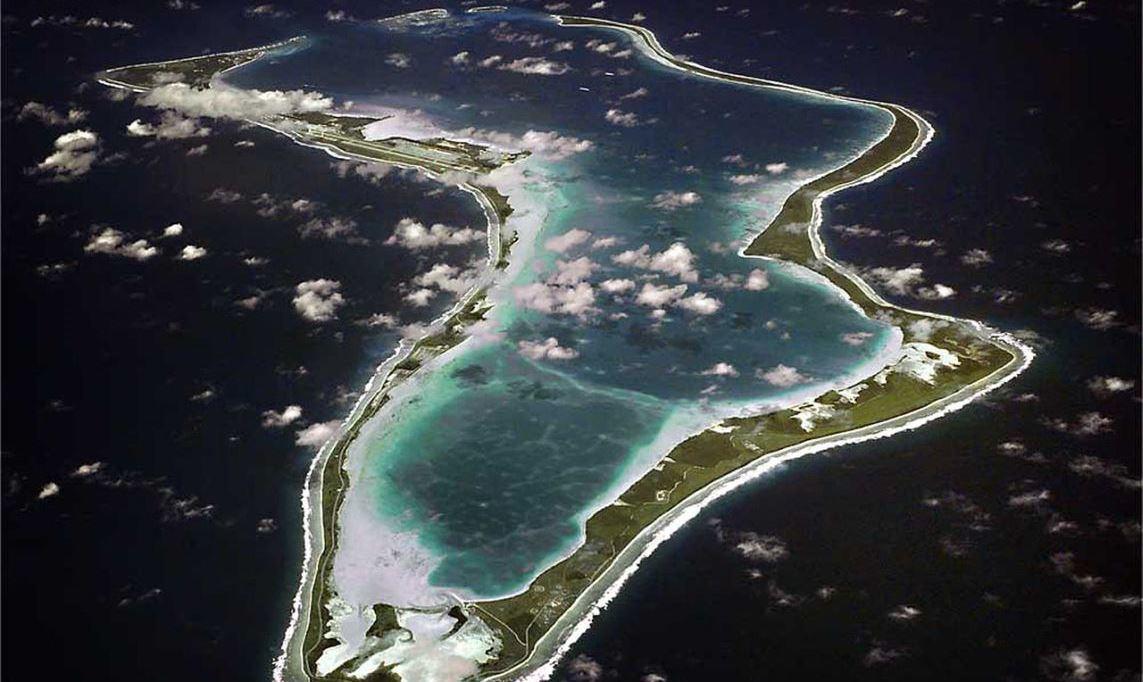
The recent decision by the Hague-based International Court of Justice that the Chagos Islands - with its huge U.S. military base at Diego Garcia - are being illegally occupied by the United Kingdom (UK) has the potential to upend the strategic plans of a dozen regional capitals, ranging from Beijing to Riyadh. For a tiny speck of land measuring only 38 miles in length, Diego Garcia casts a long shadow.
Sometimes called Washington’s “unsinkable aircraft carrier,” planes and
warships based on the island played an essential role in the first and
second Gulf wars, the invasion of Afghanistan, and the war in Libya. Its
strategic location between Africa and Indonesia and 1,000 miles south
of India gives the U.S. access to the Middle East, Central and South
Asia, and the vast Indian Ocean. No oil tanker, no warship, no aircraft
can move without its knowledge.
Most Americans have never heard of Diego Garcia for a good reason: No journalist has been allowed there for more than 30 years, and
the Pentagon keeps the base wrapped in a cocoon of national security.
Indeed, the UK leased the base to the Americans in 1966 without
informing either the British Parliament or the U.S. Congress. The February 25 Court decision has put a dent in all that by
deciding that Great Britain violated United Nations Resolution 1514
prohibiting the division of colonies before independence. The
UK broke the Chagos Islands off from Mauritius, a former colony on the
southeast coast of Africa that Britain decolonized in 1968. At the time,
Mauritius objected, reluctantly agreeing only after Britain threatened
to withdraw its offer of independence. The Court ruled 13-1 that the UK had engaged in a “wrongful act” and must decolonize the Chagos “as rapidly as possible.”
“The Great Game” in the Indian Ocean
While the ruling is only “advisory,” it comes at a time when
the U.S. and its allies are confronting or sanctioning countries for
supposedly illegal occupations - Russia in the Crimea and China in the
South China Sea.
The suit was brought by Mauritius and some of the 1,500 Chagos
islanders who were forcibly removed from the archipelago in 1973. The
Americans, calling it “sanitizing” the islands, moved the Chagossians more than 1,000 miles to Mauritius and the Seychelles, where they’ve languished in poverty ever since.
Diego Garcia is the lynchpin for U.S. strategy in the region. With
its enormous runways, it can handle B-52, B-1 and B-2 bombers, and huge
C-5M, C-17, and C-130 military cargo planes. The lagoon has been
transformed into a naval harbor that can handle an aircraft carrier. The
U.S. has built a city — replete with fast food outlets, bars, golf
courses and bowling alleys — that hosts some 3,000 to 5,000 military
personnel and civilian contractors. What you can’t find are any native Chagossians.
The Indian Ocean has become a major theater of competition between
India, the U.S., and Japan on one side, and the growing presence of
China on the other. Tensions have flared between India and China over
the Maldives and Sri Lanka, specifically China’s efforts to use ports on
those island nations. India recently joined with Japan and the U.S. in a
war game — Malabar 18 — that modeled shutting down the strategic
Malacca Straits between Sumatra and Malaysia, through which some 80
percent of China’s energy supplies pass each year.
A portion of the exercise involved anti-submarine warfare aimed at
detecting Chinese submarines moving from the South China Sea into the
Indian Ocean. To Beijing, those submarines are essential for protecting
the ring of Chinese-friendly ports that run from southern China to Port
Sudan on the east coast of Africa. Much of China’s oil and gas supplies
are vulnerable, because they transit the narrow Mandeb Strait that
guards the entrance to the Red Sea and the Strait of Hormuz that
oversees access to the oil-rich Persian Gulf. The U.S. 5th Fleet
controls both straits. Tensions in the region have increased since the Trump
administration shifted the focus of U.S. national security from
terrorism to “major power competition” — that is, China and Russia.
The U.S. accuses China of muscling its way into the Indian Ocean by
taking over ports, like Hambantota in Sri Lanka and Gwadar in Pakistan
that are capable of hosting Chinese warships.
India, which has its own issues with China dating back to their 1962
border war, is ramping up its anti-submarine forces and building up its
deep-water navy. New Delhi also recently added a long-range Agni-V
missile that’s designed to strike deep into China, and the right-wing
government of Narendra Mori is increasingly chummy with the American
military. The Americans even changed their regional military
organization from “Pacific Command” to “Indo-Pacific Command” in
deference to New Delhi.
The term for these Chinese friendly ports —”string of pearls” — was
coined by Pentagon contractor Booz Allen Hamilton and, as such, should
be taken with a grain of salt. China is indeed trying to secure
its energy supplies and also sees the ports as part of its worldwide
Road and Belt Initiative trade strategy. But assuming the “pearls” have a
military role, akin to 19th century colonial coaling stations, is a
stretch. Most the ports would be indefensible if a war broke out.
An “Historic” Decision
Diego Garcia is central to the U.S. war in Somalia, its air
attacks in Iraq and Syria, and its control of the Persian Gulf, and
would be essential in any conflict with Iran. If the current
hostility by Saudi Arabia, Israel, and the U.S. toward Iran actually
translates into war, the island will quite literally be an unsinkable
aircraft carrier.
Given the strategic centrality of Diego Garcia, it’s hard to imagine
the US giving it up — or rather, the British withdrawing their agreement
with Washington and de-colonizing the Chagos Islands. In 2016, London
extended the Americans’ lease for 20 years. Mauritius wants the Chagos back, but at this point doesn’t object to the base. It certainly wants a bigger rent check and the right eventually to take the island group back.
It also wants more control over what goes on at Diego Garcia. For
instance, the British government admitted that the Americans were using
the island to transit “extraordinary renditions,” people seized during
the Afghan and Iraq wars between 2002 and 2003, many of whom were
tortured. Torture is a violation of international law. As for the Chagossians, they want to go back.
Diego Garcia is immensely important for U.S. military and
intelligence operations in the region, but it’s just one of some 800
American military bases on every continent except Antarctica. Those
bases form a worldwide network that allows the U.S. military to deploy
advisors and Special Forces in some 177 countries across the globe. Those forces create tensions that can turn dangerous at a moment’s notice.
For instance, there are currently U.S. military personal in virtually
every country surrounding Russia: Norway, Poland, Hungary, Kosovo,
Romania, Turkey, Latvia, Lithuania, Estonia, Georgia, Ukraine, and
Bulgaria. Added to that is the Mediterranean’s 6th Fleet, which
regularly sends warships into the Black Sea.
Much the same can be said for China. U.S. military forces are
deployed in South Korea, Japan, and Australia, plus numerous islands in
the Pacific. The American 7th fleet, based in Hawaii and Yokohama, is
the Navy’s largest.
In late March, U.S. Navy and Coast Guard ships transited the Taiwan
Straits, which, while international waters, the Chinese consider an
unnecessary provocation. British ships have also sailed close to
Chinese-occupied reefs and islands in the South China Sea. The fight to de-colonize the Chagos Islands will now move to the UN General Assembly.
In the end, Britain may ignore the General Assembly and the Court, but
it will be hard pressed to make a credible case for doing so. How
Great Britain can argue for international law in the Crimea and South
China Sea, while ignoring the International Court of Justice on the
Chagos, will require some fancy footwork.
In the meantime, Mauritius Prime Minister Pravind Jugnauth calls the
Court decision “historic,” and one that will eventually allow the 6,000
native Chagossians and their descendants “to return home.”