"Gaia, the Hellenic Planet"
Some trace this knowledge in Homer , in the Vedas, in archaeological , scientifique and historic findings and some others reconfirm it in the stories revealed by the Paiute Indians who
inhabit the Great Basin and Mojave deserts of Utah, Nevada, and
California in USA and the Navaho Indians. In their language they call the Greeks Hav-Musuvs..... m.l.p.
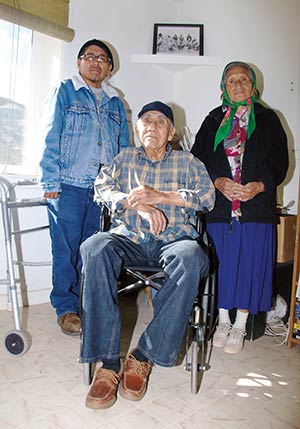
BOTTOM:
Jack Owl Sr. (center), a member of the San Juan Southern
Paiute tribal council, poses with his family at his home on Paiute
Mountain. Many of the San Juan Paiutes are quadrilingual, speaking
English, fluent Navajo, Hopi, and Paiute.
"Grandma Cly," a leader of her large family in Monument Valley.
THE SECRETS OF THE MOJAVE
(Or, The Conspiracy Against Reality) -- Page #1
[7th edition]
Compiled by 'The Group' -- Edited by 'Branton'

"AND I WILL SHOW WONDERS IN THE HEAVEN ABOVE...
"AND SIGNS IN THE EARTH BENEATH...
"BLOOD, AND FIRE, AND VAPOUR OF SMOKE..."
-- Acts 2:19 --
The author of the following story is a Navaho Indian. He revealed
this tribal secret which he learned from the Paiute Indians, who
inhabit the Great Basin and Mojave deserts of Utah, Nevada, and
California.
This native American, who went by the name Oga-Make,
related the following account in appreciation for a story on the
Navaho which appeared in the Spring of 1948 in a magazine
which was carrying numerous articles on the mysterious "signs"
or "fires" in the skies which were causing an enormous amount
of confusion and debate during that same year, as well as the
years following.
The article on the Navaho nation, which appeared in an
earlier issue, told of the suffering that their tribe had gone
through during past winter seasons, and encouraged the
readership to send goods and supplies to help them through
the upcoming winter of '48-'49, which many of them did.
In appreciation of this, Oga-Make related the following
'legend' which told of the secret history of the Americas which
ran it's course, possibly thousands of years before white men
set their foot en masse upon it's shores:
"...Most of you who read this are probably white men of a
blood only a century or two out of Europe. You speak in your
papers of the Flying Saucers or Mystery Ships as something
new, and strangely typical of the twentieth century. How could
you but think otherwise? Yet if you had red skin, and were of
a blood which had been born and bred of the land for untold
thousands of years, you would know this is not true. You would
know that your ancestors living in these mountains and upon
these prairies for numberless generations, had seen these ships
before, and had passed down the story in the legends which are
the unwritten history of your people. You do not believe? Well,
after all, why should you? But knowing your scornful unbelief,
the storytellers of my people have closed their lips in bitterness
against the outward flow of this knowledge.
"Yet, I have said to the storytellers this: now that the ships
are being seen again, is it wise that we, the elder race, keep our
knowledge to ourselves? Thus for me, an American Indian, some
of the sages among my people have talked, and if you care to, I
shall permit you to sit down with us and listen.
"Let us say that it is dusk in that strange place which you,
the white-man, calls 'Death Valley.' I have passed tobacco...to
the aged chief of the Paiutes who sits across a tiny fire from me
and sprinkles corn meal upon the flames...
"The old chief looked like a wrinkled mummy as he sat there
puffing upon his pipe. Yet his eyes were not those of the
unseeing, but eyes which seemed to look back on long trails of
time. His people had held the Inyo, Panamint and Death Valleys
for untold centuries before the coming of the white-man. Now we
sat in the valley which white-man named for Death, but which the
Paiute calls Tomesha--The Flaming Land. Here before me as I
faced eastward, the Funerals (mountains forming Death Valley's
eastern wall) were wrapped in purple-blue blankets about their
feet while their faces were painted in scarlet. Behind me, the
Panamints rose like a mile-high wall, dark against the sinking
sun.
"..."The old Paiute smoked my tobacco for a long time before he
reverently blew the smoke to the four directions. Finally he
spoke.
"'You ask me if we heard of the great silver airships in the
days before white-man brought his wagon trains into the land?'
"'Yes grandfather, I come seeking knowledge.' (Among all
tribes of my people, grandfather is the term of greatest respect
which one man can pay to another.)
"'We, the Paiute Nation, have known of these ships for
untold generations. We also believe that we know something of
the people who fly them. They are called The Hav-musuvs.'
"'Who are the Hav-musuvs?'
"'They are a people of the Panamints, and they are as ancient
as Tomesha itself.'
"He smiled a little at my confusion.
"'You do not understand? Of course not. You are not a
Paiute. Then listen closely and I will lead you back along the
trail of the dim past.
"'When the world was young, and this valley which is now
dry, parched desert, was a lush, hidden harbor of a blue water-
sea which stretched from half way up those mountains to the
Gulf of California, it is said that the Hav-musuvs came here in
huge rowing-ships. They found great caverns in the Panamints,
and in them they built one of their cities. At that time California
was the island which the Indians of that state told the Spanish
it was, and which they marked so on their maps.
"'Living in their hidden city, the Hav-musuvs ruled the sea
with their fast rowing-ships, trading with far-away peoples and
bringing strange goods to the great quays said still to exist in
the caverns.
"'Then as untold centuries rolled past, the climate began to
change. The water in the lake went down until there was no
longer a way to the sea. First the way was broken only by the
southern mountains, over the tops of which goods could be
carried. But as time went by, the water continued to shrink,
until the day came when only a dry crust was all that remained
of the great blue lake. Then the desert came, and the Fire-God
began to walk across Tomesha, The Flaming-Land.
"'When the Hav-musuvs could no longer use their great
rowing-ships, they began to think of other means to reach the
world beyond. I suppose that is how it happened. We know
that they began to use flying canoes. At first they were not
large, these silvery ships with wings. They moved with a slight
whirring sound, and a dipping movement, like an eagle.
"'The passing centuries brought other changes. Tribe after
tribe swept across the land, fighting to possess it for awhile
and passing like the storm of sand. In their mountain city still
in the caverns, the Hav-musuvs dwelt in peace, far removed from
the conflict. Sometimes they were seen in the distance, in their
flying ships or riding on the snowy-white animals which took them
from ledge to ledge up the cliffs. We have never seen these
strange animals at any other place. To these people the passing
centuries brought only larger and larger ships, moving always
more silently.'
"'Have you ever seen a Hav-musuv?'
"'No, but we have many stories of them. There are reasons
why one does not become too curious.'
"'Reasons?'
"'Yes. These strange people have weapons. One is a small
tube which stuns one with a prickly feeling like a rain of cactus
needles. One cannot move for hours, and during this time the
mysterious ones vanish up the cliffs. The other weapon is deadly.
It is a long, silvery tube. When this is pointed at you, death
follows immediately.'
"'But tell me about these people. What do they look like and
how do they dress?'
"'They are a beautiful people. Their skin is a golden tint, and
a head band holds back their long dark hair. They dress always
in a white fine-spun garment which wraps around them and is
draped upon one shoulder. Pale sandals are worn upon their
feet...'
"His voice trailed away in a puff of smoke. The purple
shadows rising up the walls of the Funerals splashed like the
waves of the ghost lake. The old man seemed to have fallen
into a sort of trance, but I had one more question.
"'Has any Paiute ever spoken to a Hav-musuv, or were the
Paiutes here when the great rowing-ships first appeared?'
"For some moments I wondered if he had heard me. Yet as
is our custom, I waited patiently for the answer. Again he went
through the ritual of the smoke-breathing to the four directions,
and then his soft voice continued:
"'Yes. Once in the not-so-distant-past, but yet many
generations before the coming of the Spanish, a Paiute chief
lost his bride by sudden death. In his great and overwhelming
grief, he thought of the Hav-musuvs and their long tube-of-death.
He wished to join her, so he bid farewell to his sorrowing people
and set off to find the Hav-musuvs. None appeared until the
chief began to climb the almost unscaleable Panamints. Then
one of the men in white appeared suddenly before him with the
long tube, and motioned him back. The chief made signs that
he wished to die, and came on. The man in white made a long
singing whistle and other Hav-musuvs appeared. They spoke
together in a strange tongue and then regarded the chief thought-
fully. Finally they made signs to him making him understand
that they would take him with them.
"'Many weeks after his people had mourned him for dead, the
Paiute chief came back to his camp. He had been in the giant
underground valley of the Hav-musuvs, he said, where white lights
which burn night and day and never go out, or need any fuel, lit
an ancient city of marble beauty. There he learned the language
and the history of the mysterious people, giving them in turn the
language and legends of the Paiutes. He said that he would have
liked to remain there forever in the peace and beauty of their life,
but they bade him return and use his new knowledge for his
people.'...."
